If you are checking ipl home device penetration depth mm, the useful answer is not one exact number. Home IPL light may be discussed around a rough 1.5 to 2.5 mm range, but that is not a fixed treatment depth and it does not prove a device will affect every follicle. What matters more is whether enough safe, usable light reaches pigmented hair often enough to slow regrowth.
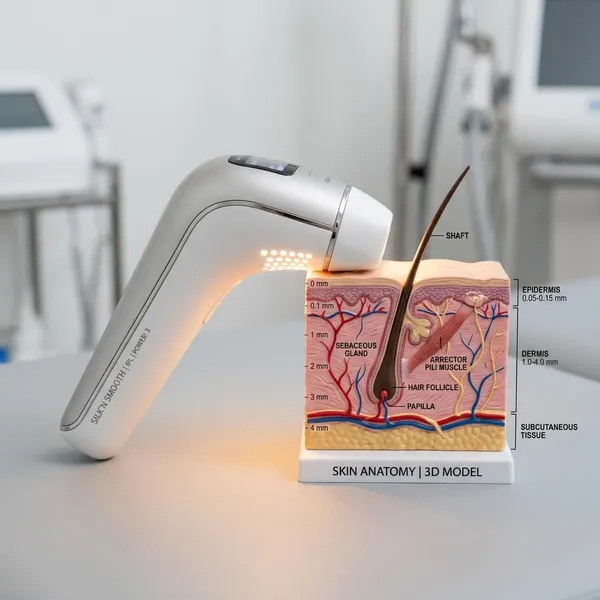
Is 1.5 to 2.5 mm an accurate IPL depth?
The 1.5 to 2.5 mm figure is best treated as a rough optical reference, not a universal IPL specification. IPL light does not travel to a clean stopping point inside the skin. It weakens gradually, scatters, and gets absorbed differently depending on the wavelength, skin tone, hair pigment, and device design.
It is not a universal IPL range
No single depth range applies to every home IPL device. Filters, pulse settings, treatment window size, and safety limits all affect how light behaves before it reaches the follicle.
Skin also changes the outcome. More pigment in the upper skin can absorb light earlier, leaving less energy for the hair. That is why a number that sounds reasonable for one person's legs may not describe what happens on the upper lip, underarms, or bikini line.
IPL uses multiple wavelengths
IPL is not a single-wavelength beam like many lasers. It uses a filtered band of light, so different parts of the pulse behave differently in skin: shorter wavelengths are more likely to be absorbed closer to the surface, while longer wavelengths may travel farther before losing strength.
- Shorter wavelengths: more surface interaction and more competition from skin pigment.
- Longer wavelengths: generally better reach, but still limited by energy, scattering, and safety settings.
- Filtered IPL bands: useful for home treatment, but less depth-specific than a targeted laser wavelength.
Optical reach differs from effective heating
Light can technically enter tissue without producing enough heat to affect hair growth. For IPL hair reduction, the real target is effective heating around pigmented hair structures, not just how far some light travels.
What controls IPL penetration depth?
IPL penetration is controlled by several factors working together. If you compare devices, do not look at a millimeter claim first. Start with wavelength range, energy density, skin suitability, and whether the treatment window makes it easy to cover the area evenly.
Wavelength
Wavelength strongly affects how far IPL light can travel. In general, longer wavelengths scatter less and can reach deeper than shorter ones, but home IPL devices usually emit a filtered range rather than one exact wavelength.
For a buyer, the useful check is whether the brand clearly explains its wavelength range and suitable skin and hair types. A vague "deep penetration" claim without those details is not very helpful.
Fluence
Fluence means energy delivered per area, often expressed as joules per square centimeter. More fluence can increase heating, but only up to the point where it remains appropriate for the user's skin tone and sensitivity.
If fluence is too low, results may be weak even if some light reaches the follicle. If it is too high, the skin may absorb too much heat near the surface. For home use, the better goal is steady, tolerable energy over repeated sessions, not the strongest possible flash.
Spot size
Spot size affects both coverage and light distribution. A larger treatment window can make broad areas like legs easier to treat evenly, while a smaller window may be easier around curved or narrow areas.
For everyday use, uneven overlap is often a bigger problem than people expect. If you skip small strips of skin or rush a large area, the result can look patchy even when the device itself is suitable.
Skin absorption
Skin absorption is one of the main limits on IPL depth. Melanin in the skin competes with melanin in the hair, so less contrast between skin and hair can mean less useful energy reaches the follicle.
- Usually better fit: darker hair with lighter surrounding skin.
- Often poor fit: white, gray, very light blond, or many red hairs because they contain little target pigment.
- Needs extra caution: deeper skin tones, recent tanning, irritated skin, or any device use outside the brand's skin tone chart.
Light scattering
Scattering makes IPL less predictable than a neat millimeter number suggests. Some light spreads sideways instead of moving straight down, so the amount of concentrated energy reaching the follicle varies by tissue structure and wavelength.
This is why two people can use the same model and see different timelines. Fine, dark leg hair may respond gradually within a normal home-use routine, while coarse dense bikini-line hair may need more patience or may be better suited to professional treatment if fast reduction is the goal.
Can home IPL reach hair follicles?
Home IPL can reach hair follicles in many suitable cases, but it does not need to affect every follicle in one session to be useful. Results depend on follicle depth, hair pigment, growth stage, and whether the device is safe for the user's skin tone.
Follicle depth varies by body area
Hair follicles do not sit at one uniform depth across the body. Lower legs, arms, underarms, face, and bikini areas can all behave differently because hair thickness, density, angle, and skin sensitivity vary.
Hair growth stage changes follicle depth
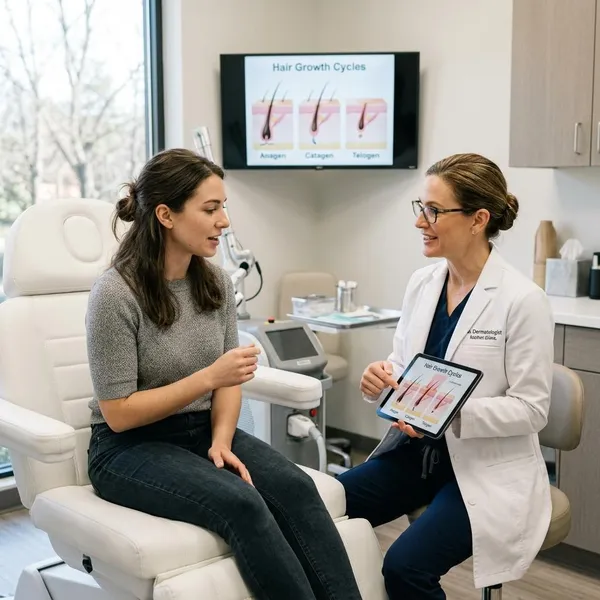
Hair is most responsive when it is in an active growth phase and still well connected to follicle structures. At other stages, the visible hair may not transfer heat as effectively, even if IPL light reaches the area.
Melanin carries heat into the follicle
Melanin is the key reason IPL works better on darker hair. The light is absorbed by pigment in the hair shaft and converted into heat, which can then spread toward the follicle structures involved in regrowth.
This also explains why depth alone is not enough. A darker hair at a moderate depth may respond better than a pale hair at a shallower depth because the pale hair does not absorb enough light.
Repeated treatments target different growth cycles
Repeated treatments matter because follicles are not synchronized. Sessions spaced according to the device instructions increase the chance of treating more hairs when they are in a responsive phase.
- Do not judge after one session: early signs are often slower regrowth or finer hair, not instant clearing.
- Do not jump to maximum intensity: use a level your skin tolerates and that matches the device guidance.
- Do not skip patchy areas: careful overlap usually matters more than rushing a larger zone.
What matters more than penetration depth?
For most people, the first check should be compatibility: skin tone, hair color, treatment area, and safety guidance. A home IPL device with a modest depth claim but a good match for your hair and skin is more useful than a dramatic depth number on a device you should not safely use.
The second check is whether the routine fits your life. Occasional use before a holiday is different from long-term hair reduction maintenance. Home IPL tends to reward steady, repeated use, so a device you can use correctly every scheduled session is usually the better choice.
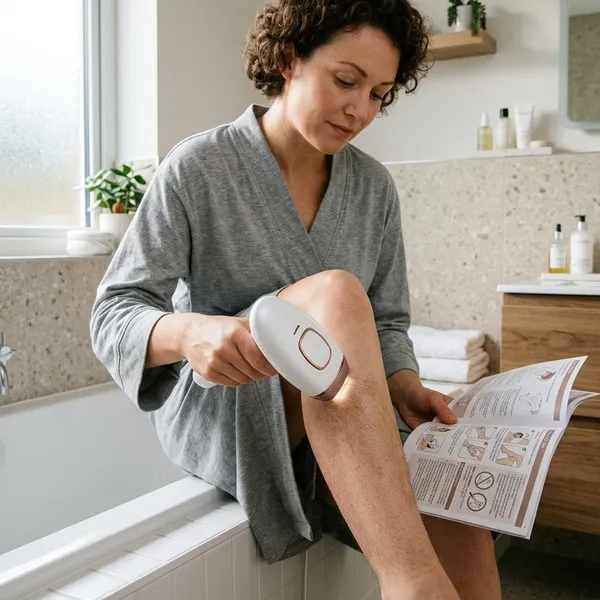
Skin and hair compatibility
Compatibility comes before depth. Check the device's skin tone chart, hair color guide, and warnings for tanning, moles, tattoos, irritated skin, medications, or medical conditions where IPL may not be appropriate.
If your hair is very light or your skin tone falls outside the device's recommended range, a higher millimeter claim will not solve the main problem. In that situation, it is better to choose a more suitable method than to push a home IPL device beyond its intended use.
Wavelength range
A wavelength range tells you more than a vague penetration claim, but only if it is presented clearly. It helps explain how the device balances surface safety with enough reach toward pigmented hair.
Energy density
Energy density matters because the follicle needs enough heat to respond. Still, higher energy is not automatically better for home use, especially on sensitive areas or skin that absorbs light easily.
Treatment consistency
Consistency often beats small technical differences between devices. If you miss sessions, shave poorly before treatment, or cover the skin unevenly, the results can lag even with a good model.
For someone who wants long-term maintenance, the best device is often the one that is simple enough to use regularly. For someone who only wants a quick fix before summer, expectations should be lower because IPL works over cycles rather than overnight.
Device safety limits
Home IPL devices are intentionally limited compared with professional systems. That is not a flaw; it is part of making them safer for non-clinical use.
The trade-off is slower, more gradual progress. If your hair is very coarse, your target area is difficult, or your skin and hair combination is borderline, professional advice may be the more sensible route instead of trying to solve the problem with a stronger home setting.
Conclusion
A home IPL device should not be judged by one penetration-depth number alone. The safer, more useful decision is to check skin and hair compatibility first, then look at wavelength range, energy density, treatment area, and whether you can follow the schedule consistently. If those pieces line up, home IPL may support gradual hair reduction; if they do not, a millimeter claim will not make the device a good match.