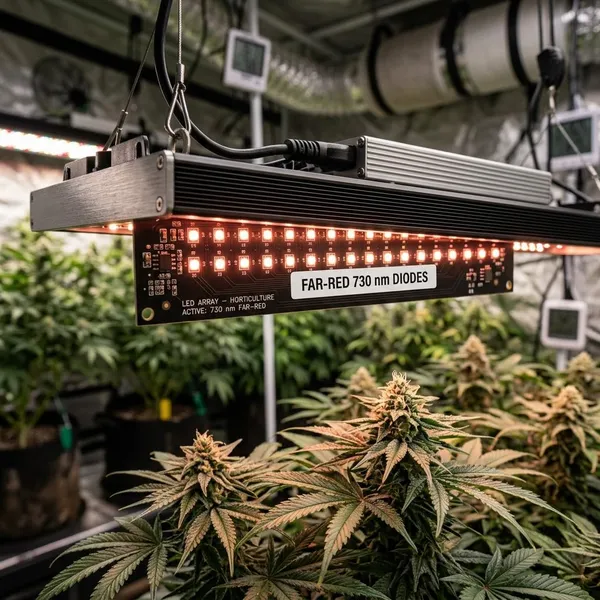
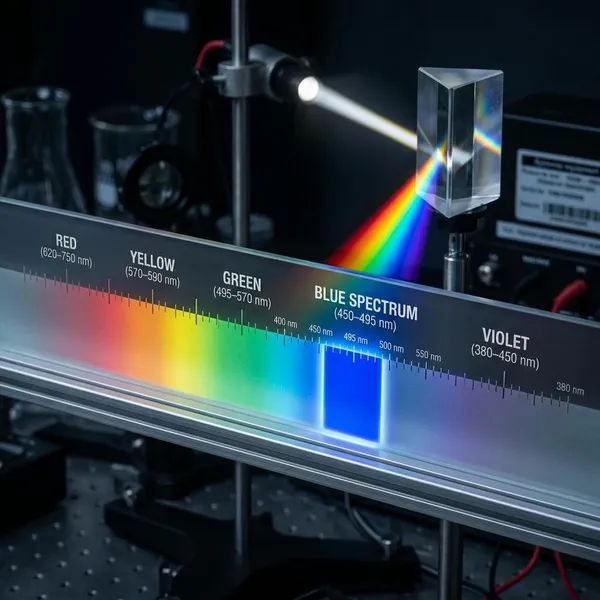
If you are looking up red light absorption wavelength, the first thing to separate is red light itself from what a red material absorbs. Red light is usually treated as roughly 620 to 780 nm, but many red dyes, filters, and solutions absorb most strongly at shorter green or blue-green wavelengths. That mismatch is normal: the absorbed light is not the same as the color that reaches your eyes.
Why do red materials absorb other wavelengths?
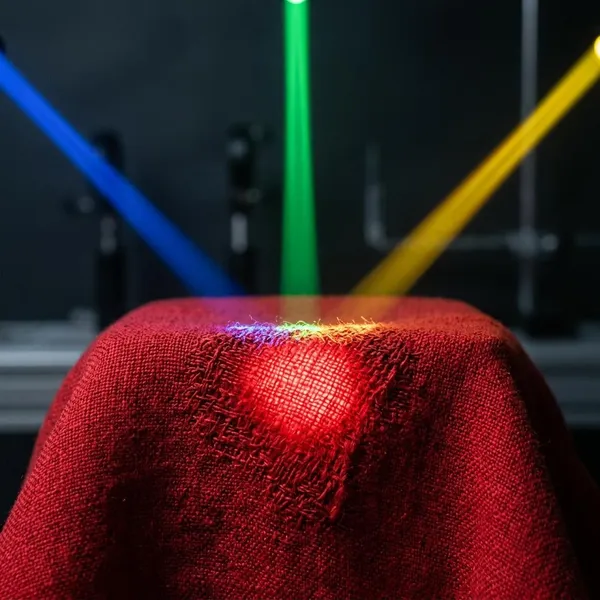
A red-looking material appears red because it removes some parts of white light and leaves more red light to be reflected or transmitted. The useful question is not only "what wavelength is red?" but also "which wavelengths does this specific sample remove?"
That difference matters in practical situations. If you are checking a red food dye in a school lab, you care about its absorbance peak. If you are choosing a red LED or laser, you care about the wavelength of the light source. Those are related, but they are not interchangeable.
They absorb more green or blue-green light
Many red materials have a strong visible absorbance band in the green or blue-green part of the spectrum, often somewhere around 490 to 570 nm depending on the substance and conditions. Removing those middle wavelengths makes the remaining light look richer in red.
- Red dye solution: may transmit red light while absorbing more near the green region.
- Red optical filter: blocks much of the blue and green light so more red passes through.
- Red pigment: reflects more red light while absorbing other visible wavelengths.
They reflect or transmit more red light
For an opaque red surface, the reflected light is what you see. For a clear red liquid or filter, transmitted light matters more. In both cases, the sample looks red because more red light reaches your eyes than many other visible wavelengths.
The remaining light makes them look red
Your eyes respond to the light left after absorption, not to the light removed by the material. A red drink, for example, can have a main absorbance peak near the green region while still looking red because the transmitted light is biased toward red.
Lighting can change the appearance without changing the material. A red fabric may look vivid in daylight but dull under a light source with little red output. That does not necessarily mean its absorption peak moved; it may simply have less red light available to reflect.
What affects a red substance's absorption peak?
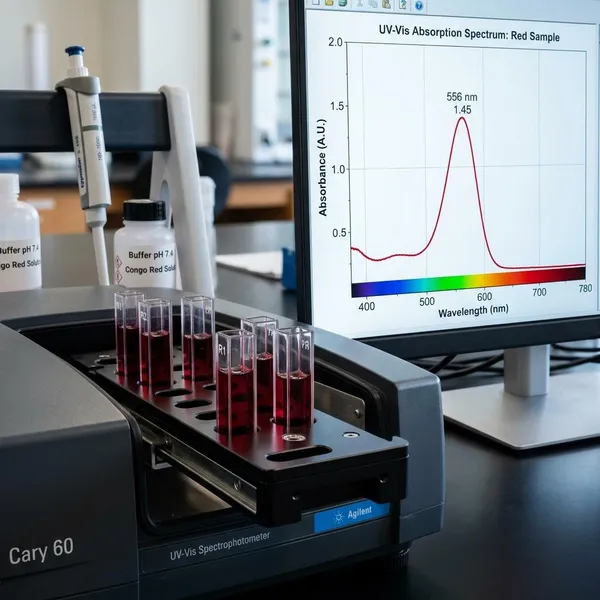
The absorption peak of a red substance is usually reported as its lambda max, the wavelength where absorbance is highest under stated conditions. The most important checks are the exact molecule first, then the solvent and pH, then the way the sample was prepared and measured.
If two sources give slightly different numbers, that does not automatically mean one is wrong. A dye measured in water at one pH can differ from the same dye measured in another solvent, a different buffer, or a less controlled sample.
Molecular structure
The molecule sets the basic absorbance pattern. Many colored compounds have electron systems that can absorb visible light, and small structural changes can shift the peak to a shorter or longer wavelength. That is why two red-looking dyes may not share the same lambda max.
Solvent
The solvent can change how a molecule's electronic states are stabilized, which may shift the peak or change the band shape. A value reported in water should not be treated as identical to a value measured in ethanol, oil, or another medium.
pH and chemical form
pH matters most when the compound can gain or lose protons. In that case, the acidic and basic forms may absorb at different wavelengths and may even look like different shades.
- Low-risk use: identifying why a classroom sample looks red may only need a general expected range.
- Higher-precision use: comparing spectra or measuring concentration needs the pH or buffer condition recorded.
Sample conditions
Concentration, clarity, path length, temperature, purity, and instrument setup can all affect the spectrum you observe. A very concentrated solution may flatten the top of the peak, while a cloudy sample can scatter light and make the absorbance curve harder to trust.
How to find the exact absorption wavelength
The exact absorption wavelength comes from the specific substance and its measurement conditions, not from the word "red." Start with the chemical identity, then match the solvent and pH, then look for a reported lambda max or measure the sample yourself.
- Name the compound. "Red dye" is too broad; "Allura Red AC" is searchable.
- Match the conditions. Solvent and pH can explain small but important differences.
- Use spectral references. Supplier sheets, lab manuals, and papers are more useful than color charts.
- Measure if it matters. A spectrophotometer gives the peak for the actual sample in front of you.
Identify the exact substance
This is the first check because color names are vague. A red sports drink, red fabric dye, red biological stain, and red cosmetic pigment can all look similar while absorbing at different wavelengths.
If you are dealing with a commercial product, look for an ingredient list, chemical name, CAS number, or supplier data sheet. Mixtures need extra caution because the spectrum may combine several colorants rather than show one clean peak.
Check the solvent and pH
A reported lambda max is only useful when the conditions are close to yours. If your sample is in water but the reference value was measured in another solvent, expect at least some possible difference.
For pH-sensitive dyes, do not skip this step. A red solution in an acidic drink and the same dye in a basic lab mixture may not give the same absorbance maximum.
Find its reported lambda max
Search with the exact compound name plus terms such as "UV-Vis spectrum," "absorbance spectrum," or "lambda max." Add the solvent or pH if you know it, because broad searches often mix conditions.
When several values appear, choose the one measured under the closest conditions rather than the one that looks most familiar. Small differences are common, especially when references use different instruments, sample preparations, or reporting conventions.
Measure it with a spectrophotometer
A spectrophotometer is the best option when the exact value matters. Instead of guessing from the visible color, you scan across wavelengths and identify where absorbance is highest.
This is especially worth doing for mixtures, old samples, unknown concentrations, or anything exposed to heat or light for a long time. A published value tells you what to expect; your scan tells you what your actual sample is doing.
Conclusion
The practical takeaway is to avoid using one number for every red material. Use 620 to 780 nm when you mean red light itself, but look for the substance's lambda max when you mean absorption. If the result will be used for a lab calculation, comparison, or quality check, identify the compound and match the conditions before trusting the wavelength.