The wavelength of blue light is usually given as about 400 to 500 nm, but a tighter 450 to 495 nm range is also common when the source wants to focus on "clear" blue rather than violet-blue or blue-green edges. The quickest way to read any chart or product spec is to check whether it is using a broad color band or a narrower technical definition.
What is the wavelength of blue light?
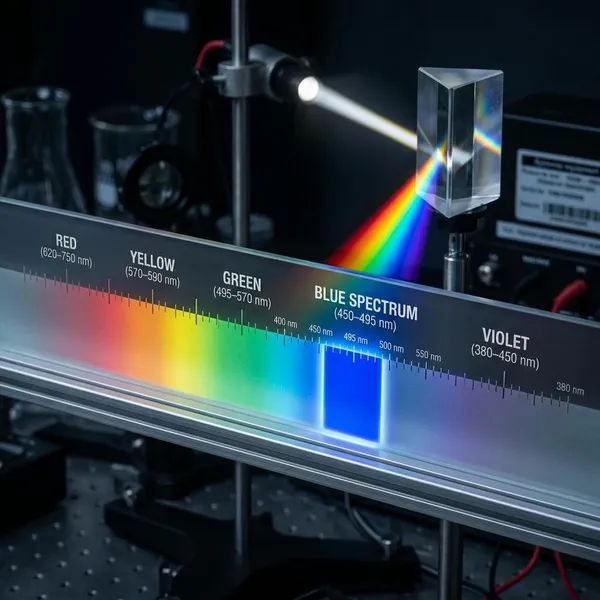
Blue light is normally placed in the short-wavelength part of visible light. For a general explanation, 400 to 500 nm is a useful range. For more precise color classification, you may see 450 to 495 nm instead.
About 400 to 500 nm in broad definitions
A broad definition usually treats blue light as roughly 400 to 500 nm. This is the range you are most likely to see in general visible-spectrum diagrams because it includes the violet-leaning and blue-green edges that many people still group with blue.
About 450 to 495 nm in narrower definitions
Some sources narrow blue light to about 450 to 495 nm because this range looks more plainly blue to many viewers. It leaves out more of the violet edge near 400 nm and more of the cyan or turquoise edge near 500 nm.
- Use the narrower range when reading display, LED, or optics specifications.
- Use the broader range when reading a school chart, health explainer, or general spectrum overview.
- Be careful with comparisons if two sources use different definitions.
Exact boundaries vary by source
The boundaries vary because "blue" is both a physical wavelength range and a human color label. A device engineer, a biology textbook, and a simple classroom chart may all draw the blue region slightly differently.
Where does blue light sit in the visible spectrum?
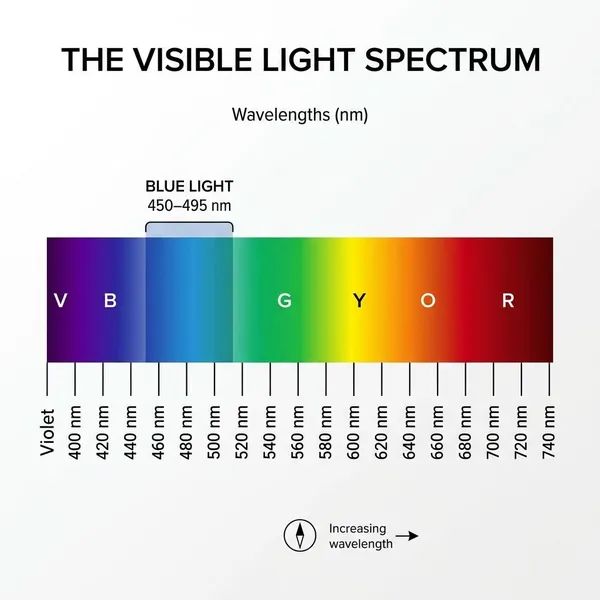
Blue light sits between violet and green in the visible spectrum. It is close to the short-wavelength end of visible light, so it is nearer to ultraviolet than colors such as yellow, orange, or red.
If you are reading a spectrum from short to long wavelengths, the order is roughly violet, blue, green, yellow, orange, and red. That position explains why blue can look slightly purple near one edge and almost turquoise near the other.
Between violet and green light
Blue fills the visible region between violet and green. Near the violet side, it may look deep or purplish; near the green side, it may look cyan or blue-green.
Above ultraviolet in wavelength
Blue light has longer wavelengths than ultraviolet light. UV sits beyond the violet end of the visible spectrum, while blue is still visible to the human eye.
Below green light in wavelength
Blue light has shorter wavelengths than green light. As the wavelength approaches the upper end of the broad blue range, the color shifts toward cyan, turquoise, or blue-green.
If a smart bulb or LED strip looks more aqua than royal blue, it may be closer to the blue-green boundary. That does not necessarily mean the label is false; it may simply be using a broad definition of blue.
How does blue light wavelength affect frequency and energy?
Wavelength, frequency, and photon energy are linked. Shorter wavelengths have higher frequency, and higher frequency means more energy per photon. Because blue light has shorter wavelengths than green, yellow, orange, and red light, it sits on the higher-energy side of the visible spectrum.
Shorter wavelengths have higher frequency
Shorter wavelengths correspond to higher frequencies because more wave cycles pass a point each second. Blue light therefore has a higher frequency than longer-wavelength visible colors such as red or orange.
Shorter wavelengths carry more photon energy
Photon energy rises as frequency rises, so shorter-wavelength blue photons carry more energy than longer-wavelength red photons. This is the physics behind the phrase "high-energy visible light."
Blue light is around 600 to 750 THz
Blue light is roughly around 600 to 750 THz, depending on the exact wavelength used. Light near 500 nm is close to the lower end of that frequency range, while light near 400 nm is close to the higher end.
| Approximate wavelength | Approximate frequency | Useful interpretation |
|---|---|---|
| 500 nm | About 600 THz | Near the blue-green edge |
| 450 nm | About 670 THz | Clear, vivid blue |
| 400 nm | About 750 THz | Near the violet edge |
How is the blue light range divided?
The blue range is often split into smaller bands because not all blue wavelengths look the same. A practical split is blue-violet at the shorter end and blue to blue-turquoise at the longer end.
This split is useful when a wavelength number needs to become a visual expectation. For example, someone choosing decorative lighting may care whether the color looks deep blue or aqua, while someone reading a technical chart may only need to know which part of the spectrum the number belongs to.
Around 400 to 450 nm for blue-violet light
Around 400 to 450 nm is the blue-violet side of the range. It sits close to violet and near the boundary with ultraviolet, so it can look purplish rather than like a standard everyday blue.
If a source includes 400 nm under blue, read that as a broad classification. Visually, 400 nm is better thought of as an edge case: still close enough to be included in some blue ranges, but not the blue most people picture first.
Around 450 to 500 nm for blue to blue-turquoise light
Around 450 to 500 nm runs from clear blue toward blue-turquoise. Wavelengths near 450 nm often look like a strong, recognizable blue; wavelengths closer to 500 nm start leaning toward cyan or green.
- For a classic blue appearance: look closer to the middle of this band, around 450 nm.
- For a cooler aqua look: expect wavelengths nearer the 490 to 500 nm edge.
- For technical reading: check whether the source counts turquoise/cyan as part of blue.
What color are common blue light wavelengths?
A wavelength number can give a better color clue than the word "blue" alone. The lower end of the range looks more violet, the middle looks more clearly blue, and the upper end drifts toward cyan or blue-green.
This is especially helpful when comparing LEDs, display colors, stage lighting, aquarium lights, or product descriptions. Two lights can both be sold as blue while producing noticeably different impressions in a room.
400 nm sits near the violet edge
400 nm sits near the violet edge of visible light. Some references include it in a broad blue range, but many people would describe it as violet or blue-violet rather than ordinary blue.
For practical interpretation, do not expect 400 nm to look like a typical blue icon or blue fabric. It is an edge wavelength, so the color name depends heavily on the chart or source you are using.
450 nm appears blue
450 nm is a strong example of clear blue light. It is less violet than 400 nm and less green-leaning than wavelengths near 500 nm, which makes it a useful reference point for "classic" blue.
500 nm sits near the blue-green edge
500 nm sits near the blue-green edge and is often described as cyan, turquoise, or blue-green. Whether a chart still counts it as blue depends on how broadly that chart defines the blue region.
This is the number to watch if you are choosing a light for appearance. If you want a deep or standard blue, 500 nm may look too green. If you want a fresh aqua or turquoise effect, it may be exactly the side of blue you are looking for.
Conclusion
For most everyday purposes, treat blue light as roughly 400 to 500 nm, then narrow it to about 450 to 495 nm when a source is clearly talking about central blue rather than the violet or blue-green edges. The practical habit is simple: check the definition being used before comparing numbers, and do not confuse visible blue light with ultraviolet just because both sit near the short-wavelength end of the spectrum.