Home IPL is not automatically safer than professional laser hair removal just because it uses less power. It can be a reasonable low-risk option for some people with light skin, dark hair, and a device that clearly matches them, but professional laser is often safer when skin tone, pigmentation history, or treatment area needs more control.
How home IPL and professional laser differ
Both methods use light energy to heat pigment in the hair follicle, but they do it in different ways. For safety, the main difference is not simply "weak versus strong." It is how precisely the light can be targeted, how much the settings can be adjusted, and how much room there is for user error.
IPL uses broad-spectrum pulsed light
IPL, or intense pulsed light, is not a true laser. It sends out a broad range of light wavelengths, usually filtered to make the treatment more useful for hair reduction. Because that light is less selective, nearby skin can absorb some of the heat too.
That is why IPL tends to be most straightforward on a classic low-risk match: light skin with dark, coarse hair. If your skin is tanned, medium-deep, or prone to dark marks after irritation, the safety margin becomes smaller because the skin itself may absorb more of the energy.
Laser uses specific wavelengths
Professional laser hair removal uses a specific wavelength rather than broad-spectrum light. Different laser types behave differently in the skin, so a clinic may choose one approach for lighter skin and another for darker or more reactive skin. The machine can be stronger than a home IPL device, but better targeting and trained adjustment can make the treatment safer for the right candidate.
Home IPL offers fewer treatment adjustments
Most home IPL devices are deliberately simple. You may have a few intensity levels, a skin tone sensor, and safety locks, but you usually cannot adjust wavelength, pulse duration, spot size, or cooling in a meaningful way.
That simplicity helps prevent some misuse, but it also limits flexibility. A lower-leg treatment in winter on untanned skin is very different from trying to treat the upper lip after recent sun exposure. At home, people often compensate by guessing: turning the device up when results seem slow, repeating passes, or treating a sensitive area too often.
Professional laser allows more parameter control
In a clinic, settings can be matched more closely to your skin tone, hair thickness, treatment area, tanning history, and previous reactions. A provider can also pause, cool the skin, change settings, or delay treatment if your skin does not look ready that day.
- Better screening: recent tanning, active skincare, medications, and pigment history can be reviewed before treatment.
- Area-specific settings: underarms, bikini line, legs, and face may not need the same approach.
- Less overlap risk: a trained provider is less likely to repeatedly pulse the same patch of skin by accident.
- Earlier reaction checks: unusual redness, swelling, or heat can be handled before the whole area is treated.
How skin tone changes the safety decision
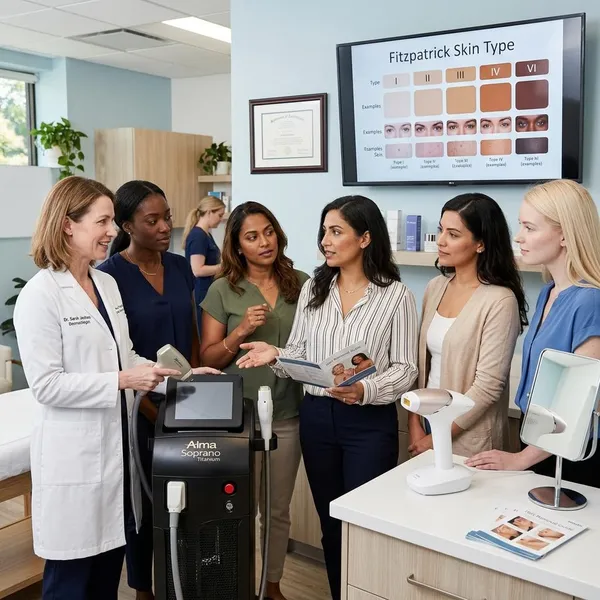
Skin tone is often the deciding factor. Light-based hair removal targets melanin, but melanin is also present in the skin. When the skin has more pigment, or when it is recently tanned, there is a higher chance that the skin absorbs too much heat instead of the energy staying focused on the hair follicle.
More skin pigment can raise IPL risk
More skin pigment can make IPL less forgiving because broad-spectrum light is not as selective as a properly chosen laser. The possible problems are not just short-lived redness. Burns, blistering, tenderness, and post-inflammatory hyperpigmentation can happen when the device is not a good match or when recently tanned skin is treated too soon.
This does not mean every person with deeper skin must avoid all light-based hair removal. It does mean that a simple home device chart may not be enough if your tone sits near the edge of the approved range, if you tan easily, or if your face is noticeably more pigmented than your body.
Home IPL compatibility varies by device
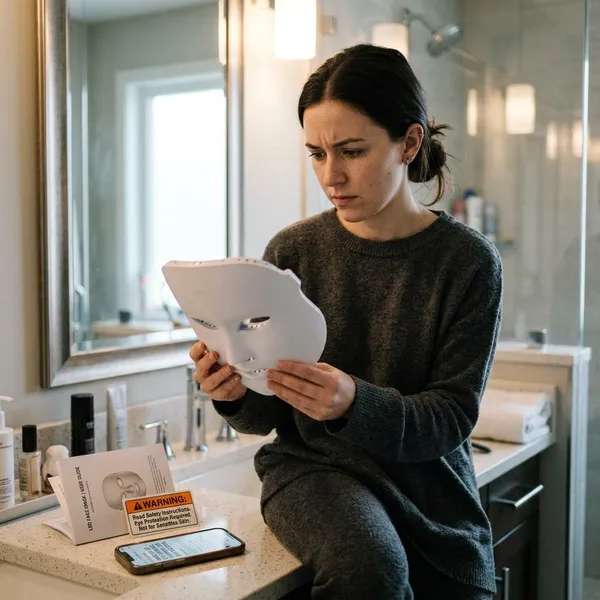
Two home IPL devices can have very different safety limits. Before using one, check the official manufacturer guidance rather than relying on a short product listing or a social media result.
- Match your current skin tone: use your present shade, not your winter shade, if you have been in the sun.
- Check hair color: dark hair usually responds best; blond, gray, red, or very fine hair may lead to poor results and overuse.
- Review restricted areas: many devices have stricter rules for the face, bikini area, or areas near the eyes.
- Do a real patch test: wait the full time recommended by the device instructions before treating a larger area.
- Stop for warning signs: increasing pain, blistering, crusting, or visible color change is not something to push through.

Professional laser offers more treatment options
Professional laser can be safer for a wider range of skin tones because the provider may have access to different laser types and settings. For darker skin, clinics often consider longer-wavelength options such as Nd:YAG, although the safest choice still depends on the person, the area, and the provider's experience.
Device and wavelength selection still matter
Professional treatment is not automatically safe just because it happens in a clinic. The provider should be able to explain why a certain device is suitable for your skin tone and hair type, whether a patch test is sensible, and how they reduce surface heat. If a clinic treats every skin tone with the same casual explanation, that is a reason to be cautious.
When professional laser may be a better choice
Professional laser becomes the more sensible safety choice when there is uncertainty. If you are unsure whether your device matches your skin, whether your pigmentation history matters, or whether the area is appropriate for home treatment, guessing at home is not a good plan.
Your skin tone needs tailored treatment
If your skin is medium-deep to dark, changes a lot between winter and summer, or tans easily, professional laser is usually the safer starting point. A year-round runner treating sun-exposed legs has a different risk profile from someone treating untanned lower legs in winter, even if both people technically fall within a device's chart.
Your IPL compatibility is uncertain
Uncertainty is enough reason to pause. This includes being unsure about your Fitzpatrick skin type, using strong actives such as retinoids or exfoliating acids, having recent sun exposure, or wanting to treat a curved area that is easy to overlap, such as the jawline or bikini line.
You have had pigmentation problems before
A history of melasma, post-inflammatory hyperpigmentation, or dark marks after acne, waxing, burns, or friction should make you more cautious with home IPL. Your skin may react strongly even to mild heat or irritation, so professional assessment is usually worth it before treating a large area.
You want professional assessment and monitoring
Professional monitoring matters when treatment is not a one-time decision. Your skin may be freshly tanned one month, irritated from skincare the next, or showing finer regrowth later in the course. A home device cannot interpret those changes for you.
This also matters if you want to switch from home IPL to professional laser. Many clinics prefer some time between treatments so the skin can settle and regrowth can be assessed, but the right timing varies. Tell the provider exactly what device you used, when you last used it, and whether you had any redness, burns, or pigment changes.
Conclusion
Lower power can make home IPL feel like the safer option, but the safer choice is the one that matches your skin, hair, area, and risk history. If you are a low-risk match and follow the device instructions carefully, home IPL may be reasonable; if you have darker or recently tanned skin, past pigmentation problems, uncertain compatibility, or a hard-to-treat area, professional laser is usually the more cautious route.