Choose a red light therapy panel by checking what reaches you in normal use, not by chasing the biggest wattage or LED count. Start with irradiance at your real treatment distance, confirm the exact red and near-infrared wavelengths, then decide whether the size, mounting, heat control, and instructions make the panel easy enough to use consistently.
How to compare panel irradiance
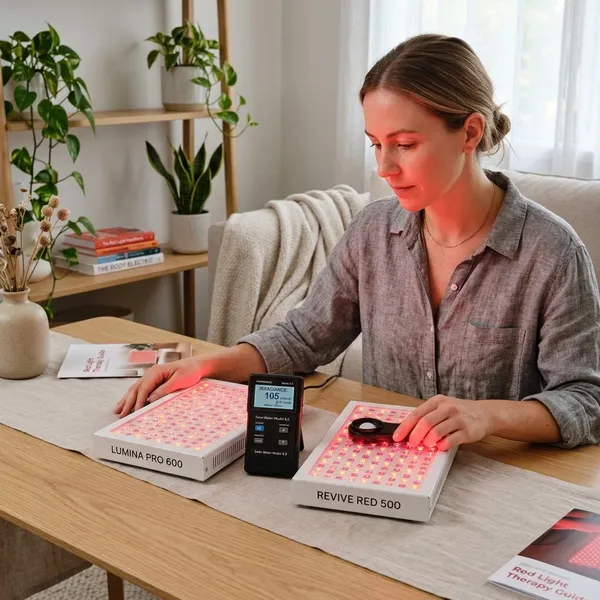
Irradiance is the amount of light power reaching a given area of skin, usually shown in mW/cm². It matters because it helps you judge whether a panel can deliver a practical session at the distance you will actually stand or sit from it.
A strong-looking number is only useful when you know the test distance and measuring conditions. A close-range reading may look impressive on a product page, but it can say very little about a comfortable daily setup.
Check output at your treatment distance
Your first check should be the irradiance at the distance you expect to use most often. If you plan to treat your face or one knee, you may sit closer; if you want front-body or back coverage, you will probably stand farther away so the light spreads over a larger area.
Compare measurements at similar distances
A panel listed at 120 mW/cm² from 6 inches cannot be fairly compared with one listed at 80 mW/cm² from 12 inches. The larger number may simply come from measuring closer to the LEDs.
When distances do not match, treat the comparison as incomplete. The more transparent brand is usually the easier one to trust, especially if it shows several distances and explains how the measurement was taken.
Match output with treatment time
Irradiance only becomes useful when paired with session length. A higher-output panel may allow shorter sessions, while a lower-output panel may still be reasonable if you do not mind spending more time in front of it.
- For quick targeted use: prioritize enough output at a close, comfortable distance.
- For larger body areas: check whether the panel still performs well when you stand farther back.
- For daily routines: avoid setups that require long, awkward sessions you are unlikely to maintain.
Avoid relying on peak numbers alone
Peak irradiance can come from a small hotspot in the center of the panel. That does not always represent the average output across the area you will treat.
Ask a more practical question: does the panel provide enough usable light across the treatment area at your normal distance? This is also why wattage alone is not a good buying shortcut. Wattage tells you electrical power use; irradiance tells you more about the light reaching your body.
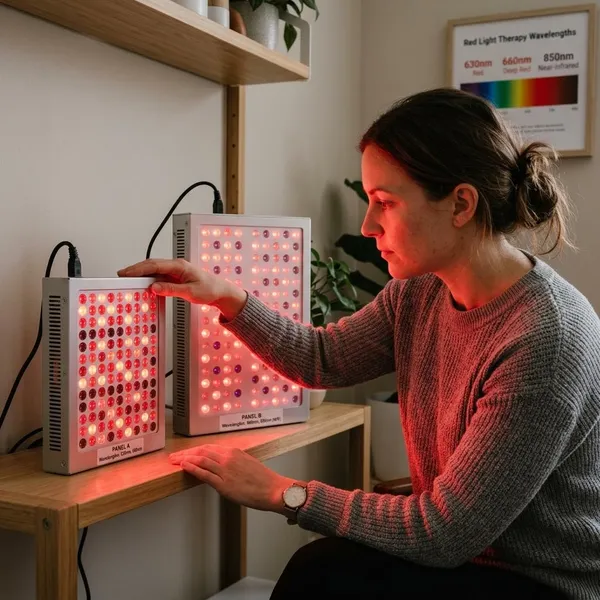
How to compare red light wavelengths
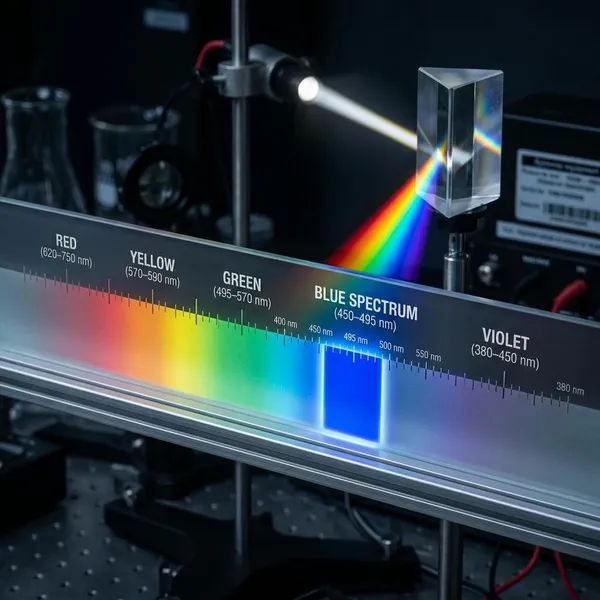
Wavelength tells you what type of light the panel emits. For shopping purposes, exact wavelength numbers are more helpful than broad labels such as "red light," "near-infrared," or "full spectrum."
Check the exact wavelengths
Look for specific numbers such as 630 nm, 660 nm, 810 nm, 830 nm, or 850 nm. Exact disclosure makes comparison easier and gives you something concrete to check against any third-party report.
Be more cautious when a product page only uses vague phrases like "therapeutic light technology." Near-infrared light is not visible in the same way red light is, so you cannot confirm it just by looking at the panel.
Match wavelengths to your main goal
If your routine is mostly face, neck, or skin appearance, red wavelengths usually deserve more attention. If your interest is larger body areas, muscles, or joints, near-infrared options may be more relevant because they are commonly chosen for deeper-area routines.
Look for red and near-infrared options
A panel with both red and near-infrared light is usually the best starting point for home use. It avoids the common mistake of buying a very narrow device and then realizing it only suits one type of session.
- Red light: often used for more surface-level routines, especially face and skin-focused use.
- Near-infrared: commonly chosen when the goal involves broader body areas or deeper tissue support.
- Mixed panels: useful when more than one person in the home may use the device for different reasons.
Avoid vague full-spectrum claims
"Full spectrum" sounds impressive, but it is not enough by itself. A better product page lists exact wavelength peaks and explains how much of the panel's output is actually coming from those bands.
More listed wavelengths are not automatically better. If a brand names many bands but does not show output, testing, or design details, the claim may be more marketing than useful buying information.
What quality and safety features matter
Once irradiance and wavelength look reasonable, shift your attention to ownership quality. A panel used several times a week needs reliable cooling, stable mounting, clear instructions, and a company that will help if something fails.
This is where many weak products become easier to spot. They may talk loudly about power and LED count but give very little detail about testing, heat, eye guidance, mounting, warranty, or support.
Third-party test reports
Independent test reports can help confirm whether the panel emits the wavelengths and output the brand claims. The most useful reports identify the tested model, measurement distance, wavelength peaks, and irradiance readings.
If a company shares only polished graphics without the test conditions, treat the data carefully. Third-party evidence is especially useful for near-infrared output because it is harder for a buyer to verify visually.
Reliable heat management
Heat control affects comfort and durability. A panel that becomes hot, noisy, or unstable during repeated sessions may be frustrating even if its specs look good.
Check for practical signs of cooling: fan design, airflow openings, housing materials, and guidance for longer sessions. This matters more for large panels and for people planning frequent year-round use rather than occasional short sessions.
Clear treatment guidance
A good panel should give clear starting guidance for distance, time, and frequency. It should not leave a beginner guessing whether to stand 3 inches away or 18 inches away.
- Distance guidance: should match the published irradiance data.
- Session timing: should be realistic enough to repeat consistently.
- Safety notes: should mention eye comfort, positioning, and normal use limits.
Stable mounting options
Mounting is easy to underestimate. A panel that is awkward to hang, angle, or move often gets used less, even when the technical specs are strong.
For a small apartment or bedroom, a tabletop stand or door mount may be more practical than a large floor setup. For a home gym or dedicated wellness space, a rolling stand or larger mounted panel may make regular full-body sessions much easier.
Strong warranty and support
A red light therapy panel is not a throwaway purchase, so warranty and support should be visible before checkout. Check the warranty length, return policy, replacement process, and whether customer support is easy to contact.
Good support also helps with setup questions, mounting issues, and understanding separate red and near-infrared controls. If those details are hard to find before buying, getting help later may not be easy either.

How to choose the right panel
The right panel depends on your routine, not on the most expensive model. A compact panel can be the smarter choice for targeted use, while a larger panel can save time if you want broader coverage several times a week.
Prioritize coverage for full-body use
If your goal is torso, back, legs, or half-body sessions, coverage matters because it reduces repositioning. A larger panel can make the routine shorter and easier to repeat.
Prioritize flexibility for targeted use
For face, neck, hands, knees, shoulders, or one sore area, a compact or mid-size panel may be more practical than a large unit. It is easier to position, store, and move around the house.
This is especially true for occasional users. If you only want short targeted sessions, a huge panel with a heavy stand may create more friction than benefit.
Prioritize output transparency for easy comparison
When two panels look similar, choose the one that gives clearer data. Published irradiance at realistic distances, exact wavelength peaks, and test details are more useful than big wattage claims.
| Buying situation | What to favor | What to avoid |
|---|---|---|
| Comparing similar panels | Clear irradiance and wavelength data | One unexplained peak number |
| Buying for full-body use | Coverage plus output at distance | A small panel that requires constant repositioning |
| Buying for targeted use | Easy positioning and simple controls | A bulky setup you will avoid using |
Prioritize usability for consistent treatment
Usability is the final filter because consistency is where the purchase either works or fails. A built-in timer, simple controls, stable stand, and clear quick-start instructions can matter more than a small difference in specs.
- Choose easy controls if more than one person will use the panel.
- Choose stable mounting if you plan longer or larger-area sessions.
- Choose manageable size if storage space is limited.
- Choose clear guidance if this is your first panel.
Conclusion
A good panel is the one with honest output data, exact wavelengths, enough coverage for your main use, and a setup you will not dread using. If a product hides its measurement distance, leans on vague spectrum claims, or makes mounting and support unclear, keep looking; the best specs are only useful when they translate into a realistic routine.