If you are comparing red light therapy panels, wavelength accuracy is one of the specs worth checking before irradiance numbers or glossy feature claims. A panel does not need to hit a wavelength with laboratory perfection, but its real output should stay close to the advertised peaks, remain reasonably narrow, and stay stable during a normal session.
What does precise wavelength delivery mean in a red light therapy panel?
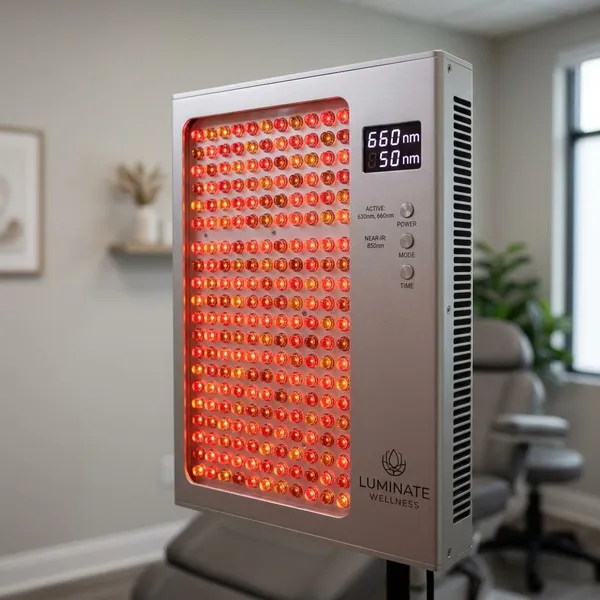
Precise wavelength delivery means the panel produces light close to the wavelengths printed on its spec sheet, instead of using those numbers loosely as marketing labels. For a buyer, the practical question is simple: if a device claims 660 nm and 850 nm, can the brand show that those are actually the main peaks during real use?
The best first check is not the longest wavelength list. Look for measured spectral data, stated tolerance ranges, and some explanation of how the panel behaves after it has warmed up.
Peak wavelengths stay close to their stated targets
The peak wavelength is the highest point in the panel's spectral output. If a panel is sold as 660 nm, the measured peak should sit close to 660 nm, not drift far enough that the label becomes more of a rough category than a real specification.
A tiny difference, such as 1–2 nm, is usually not the issue for home buyers. A bigger concern is a brand that gives exact-sounding numbers but provides no tolerance, no graph, and no test conditions. If you are choosing between two similar panels, the one with honest measurement data is usually easier to trust than the one with cleaner marketing copy.
Spectral output stays within a controlled range
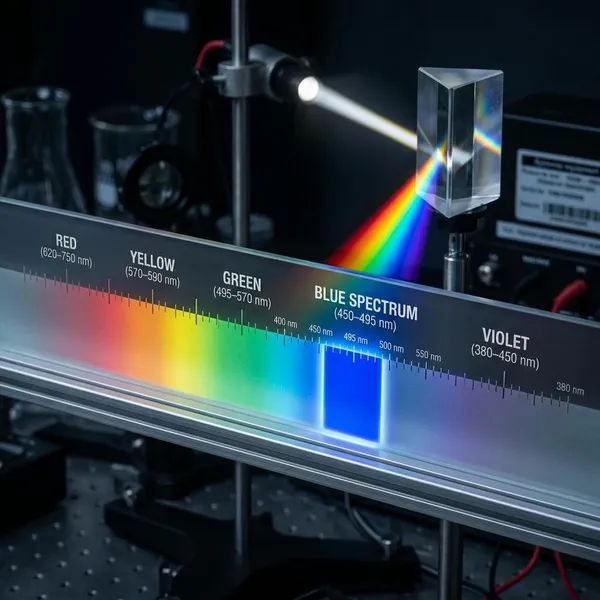
LEDs do not emit one perfectly thin line of light. They emit a band around the peak, so a "660 nm" LED also produces nearby wavelengths. That spread is normal, but it should be reasonably controlled and visible in a spectrometer graph.
Diode-to-diode variation stays consistent
One panel may contain dozens or hundreds of LEDs, and they should not all behave like separate little products. Better diode matching helps the treatment area stay more uniform, especially on larger half-body or full-body panels.
- Small panel: minor variation is less likely to affect the whole routine.
- Large panel: uneven diode batches can make one area of the panel slightly different from another.
- Shared household panel: consistency matters more because different people may stand in different positions.
Output remains stable during treatment
Wavelength delivery also depends on what happens after the panel has been running for several minutes. Heat can affect LED performance, so cooling design, drive current, and housing design are not just durability details; they can influence how repeatable the session feels.
For occasional short sessions, small shifts may be less important. For a long-term routine where you use the same distance and timing every week, stable warmed-up output matters more because you are trying to repeat the same exposure, not just turn on a bright device.
Why does wavelength accuracy matter?
Wavelength accuracy matters because it protects the meaning of the panel's specs. If the real output is poorly centered, too broad, or unstable, then treatment time and irradiance numbers become harder to interpret.
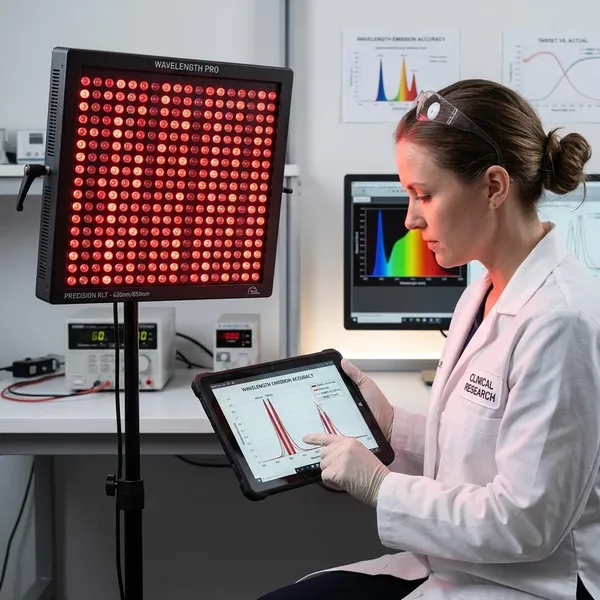
It keeps light within the intended wavelength range
If you buy a red and near-infrared panel, you are usually choosing it for a reason: red light for more surface-focused routines, near-infrared for broader body use, or both for flexibility. Accurate wavelength delivery helps make sure the panel actually fits that choice.
This does not mean you need to obsess over every nanometer. It means the advertised wavelength should be close enough, documented enough, and stable enough that the label still means something.
It makes treatment output more consistent
Consistency is what makes a panel useful as a routine tool. If the LEDs vary heavily across the panel or the output changes noticeably as the device warms up, two sessions with the same timer and distance may not be as comparable as they look.
It makes device specs easier to verify
A brand that provides a spectral graph, tolerance range, or third-party test report gives you something to check. A brand that only says "advanced spectrum" or "professional-grade wavelengths" is asking you to accept a claim without much evidence.
When reading a product page, give more weight to specific measurement details than to broad quality phrases. Useful details include the tested distance, whether the panel was warmed up, and whether the data came from internal testing or an outside lab.
It supports more reliable dosing
Dosing is not only about minutes and distance. It also depends on what light is being delivered. If the spectral profile is uncertain, your routine becomes harder to compare or adjust.
- Check first: real spectral data for the advertised wavelengths.
- Check next: tolerance, FWHM, or graph shape.
- Check after that: cooling design and consistency claims.
- Be cautious: panels that advertise many wavelengths but show no measurement evidence.
Which wavelengths should a precise panel deliver?
Most consumer panels focus on red light around 630–660 nm and near-infrared light around 810–850 nm. A precise panel does not need to include every popular number, but it should accurately deliver the wavelengths it claims to use.
| Common range | Usually chosen for | What to verify |
|---|---|---|
| 630–660 nm | Skin-focused and surface-level routines | Measured red-light peak near the advertised value |
| 810–850 nm | Deeper tissue-oriented and broader body use | Near-infrared output confirmed by spectral data |
| Red + near-infrared | Mixed household goals | Both channels genuinely present and reasonably balanced |
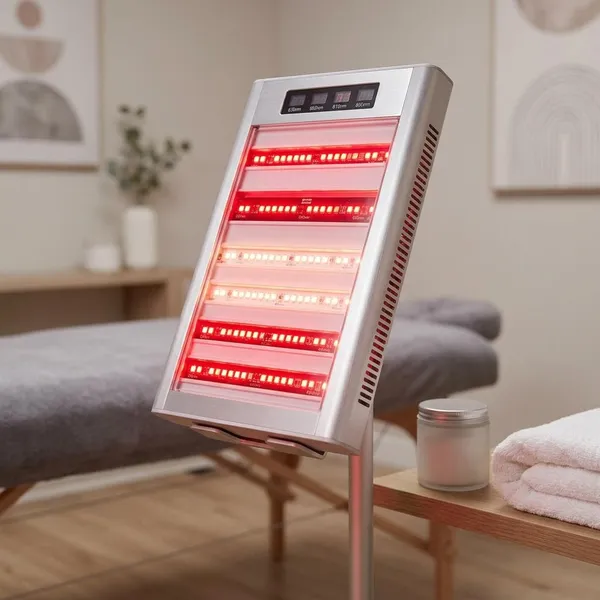
How to match panel wavelengths to your goal
Start with your main use case, then check whether the panel's wavelength data supports it. That order keeps you from buying based on the most technical-looking product page instead of the device that actually fits your routine.
630–660 nm for skin-focused use
If your main goal is a face or skin-focused routine, begin with panels that clearly document red output around 630–660 nm. You may still choose a mixed panel, but do not pay extra for near-infrared features if the red-light performance is poorly explained.
- Good sign: a red peak shown on a spectral graph.
- Useful detail: stated wavelength tolerance or FWHM.
- Weak sign: beauty claims with no measured output.
810–850 nm for deeper tissue use
For deeper tissue-oriented routines, look more closely at 810–850 nm near-infrared output and thermal stability. A panel used for larger body areas or longer-term recovery routines should be able to show what it emits after warm-up, not only what the spec sheet says.
Red plus near-infrared for mixed goals
Choose red plus near-infrared when flexibility matters more than specialization. This is usually the practical route for a household panel, a general wellness setup, or a buyer who does not want to replace the device later when their routine changes.
- Define the main routine. Skin-first, recovery-first, or mixed use?
- Match the range. Red for surface-focused use, near-infrared for broader body routines, or both for flexibility.
- Ask for proof. Look for spectral graphs, tolerance ranges, or third-party testing.
- Avoid vague precision claims. "Medical-grade spectrum" means little without measured output.
Conclusion
A precise red light therapy panel is not the one with the most impressive wavelength list; it is the one that can show its peaks, keep its output controlled, and stay consistent during a normal session. If the brand cannot document the wavelengths it advertises, treat the claim as a marketing hint rather than a reliable buying spec.