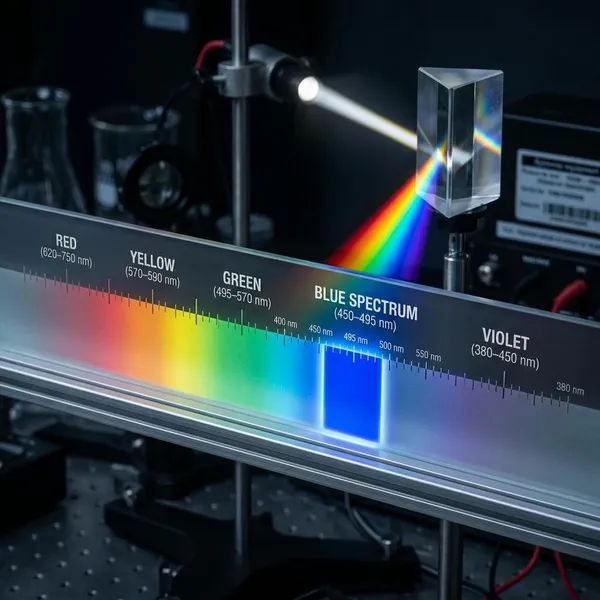
Red light is usually about 620 to 750 nm, which corresponds to roughly 484 to 400 THz. The shorter end of red has the higher frequency, and the deeper, longer-wavelength end has the lower frequency. If you only remember one example, 660 nm is about 454 THz.
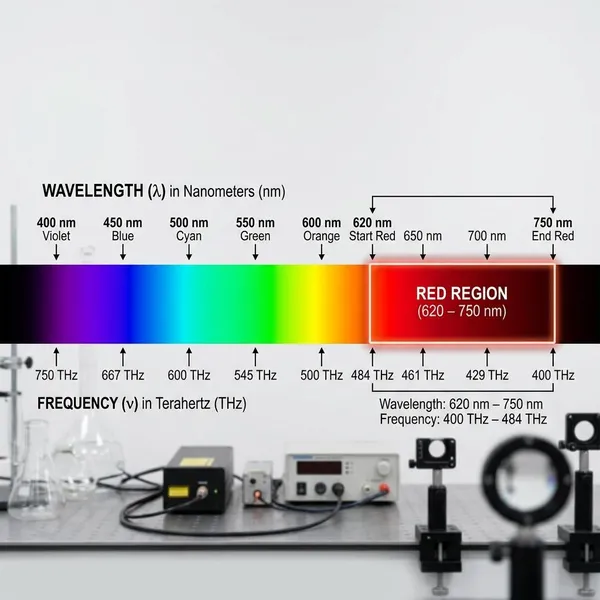
What are the wavelength and frequency of red light?
Red light can be described by wavelength or by frequency. Wavelength is the more common number on LED labels and therapy panels, while frequency is more common in physics problems and spectrum tables. They describe the same light, just from opposite sides of the wave relationship.
| Red light value | Typical number | What it tells you |
|---|---|---|
| Wavelength | About 620 to 750 nm | Where red sits on the long-wavelength edge of visible light |
| Frequency | About 484 to 400 THz | How fast the light wave oscillates |
| Common reference point | 660 nm ≈ 454 THz | A useful check for LEDs and basic calculations |
Wavelength is about 620 to 750 nm
The usual visible red range is about 620 to 750 nanometers. Around 620 nm, red can look closer to orange-red; toward 700 nm and above, it becomes deeper red and approaches the edge of human vision.
If you are reading a device label, treat a number like 630 nm, 650 nm, or 660 nm as a specific red wavelength, not as the whole red range. A single LED is usually centered around a narrow band, so "660 nm" does not mean it emits every red wavelength from 620 to 750 nm.
Frequency is about 400 to 484 THz
Red light frequency is roughly 400 to 484 terahertz. The order can feel backward at first: 620 nm is near the higher-frequency end of red, while 750 nm is near the lower-frequency end.
660 nm is about 454 THz
660 nm is about 454 THz. It is a handy reference because 660 nm appears often in red LEDs and red light therapy product descriptions, and it is still visible red rather than infrared.
- 660 nm = 6.60 × 10^-7 m
- f = 3.00 × 10^8 / 6.60 × 10^-7
- f ≈ 4.54 × 10^14 Hz = 454 THz
Where does red light sit in the visible spectrum?
Red sits at the long-wavelength end of the visible spectrum, next to infrared. That position explains why red has lower frequency than orange, yellow, green, blue, or violet light. For everyday use, the main boundary to watch is the difference between visible red and near-infrared.
It has the longest visible wavelengths
Among the colors humans normally see, red has the longest wavelengths. That is why values such as 630 nm and 660 nm are red, while higher values beyond the visible edge start moving into infrared.
It has the lowest visible frequencies
Because red has the longest visible wavelengths, it also has the lowest visible frequencies. This is a useful shortcut for schoolwork or quick chart reading: moving from violet toward red means wavelength increases and frequency decreases.
It sits next to infrared
Red is the last visible color before infrared. The exact visual boundary is not perfectly sharp for every person or light source, but wavelengths longer than the red edge are generally treated as infrared rather than visible red.
How are wavelength and frequency related?
Wavelength and frequency move in opposite directions. Longer wavelength means lower frequency; shorter wavelength means higher frequency. The relationship is simple, but it is the reason red's wavelength range and frequency range appear reversed.
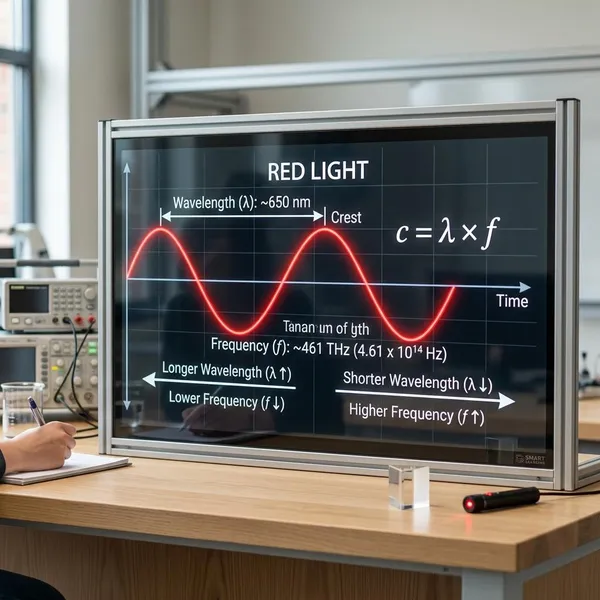
Longer wavelength means lower frequency
A longer wavelength has fewer wave cycles passing a point each second, so its frequency is lower. Within red light, 750 nm has a lower frequency than 660 nm, and 660 nm has a lower frequency than 620 nm.
This is the first thing to check if you are solving a homework problem: the larger nm value should produce the smaller THz value.
Shorter wavelength means higher frequency
Shorter wavelengths pack more cycles into the same distance, so their frequency is higher. That is why the orange-red edge around 620 nm is higher in frequency than deeper red wavelengths such as 700 nm.
The formula is f = c / λ
The frequency formula is f = c / λ, where f is frequency, c is the speed of light, and λ is wavelength. Use about 3.00 × 10^8 m/s for the speed of light unless your class or source gives a more precise value.
How to calculate red light frequency
To calculate red light frequency, handle the units before worrying about the arithmetic. This is useful whether you are checking a physics answer, comparing a 630 nm LED with a 660 nm LED, or trying to understand why a therapy panel lists both red and near-infrared wavelengths.
Convert nanometers to meters
Start by converting nanometers to meters. Since 1 nm = 1 × 10^-9 m, a wavelength of 660 nm becomes 6.60 × 10^-7 m.
- 630 nm = 6.30 × 10^-7 m
- 660 nm = 6.60 × 10^-7 m
- 700 nm = 7.00 × 10^-7 m
Divide the speed of light by wavelength
Next, divide the speed of light by the wavelength in meters. For 660 nm, the setup is f = (3.00 × 10^8) / (6.60 × 10^-7), which gives about 4.54 × 10^14 Hz.
Convert hertz to terahertz
Finally, convert hertz to terahertz by dividing by 10^12. So 4.54 × 10^14 Hz becomes about 454 THz.
- 620 nm ≈ 484 THz
- 660 nm ≈ 454 THz
- 750 nm ≈ 400 THz
Conclusion
Red light is easiest to understand by keeping the direction of the relationship clear: as the wavelength gets longer, the frequency gets lower. For most practical reading, 620 to 750 nm and roughly 484 to 400 THz are the numbers to use, with 660 nm ≈ 454 THz as a reliable reference point. When comparing labels, check the wavelength first; it tells you whether you are looking at visible red or something closer to infrared.