If you are comparing LED face masks, visible light energy is not just about which color looks brightest. The useful question is whether the mask gives the right wavelength, enough measured output, and a realistic treatment time for your skin concern. Blue, red, green, and yellow modes can all behave differently, so the best choice is the mode with clear specifications and instructions, not the one that sounds the most powerful.
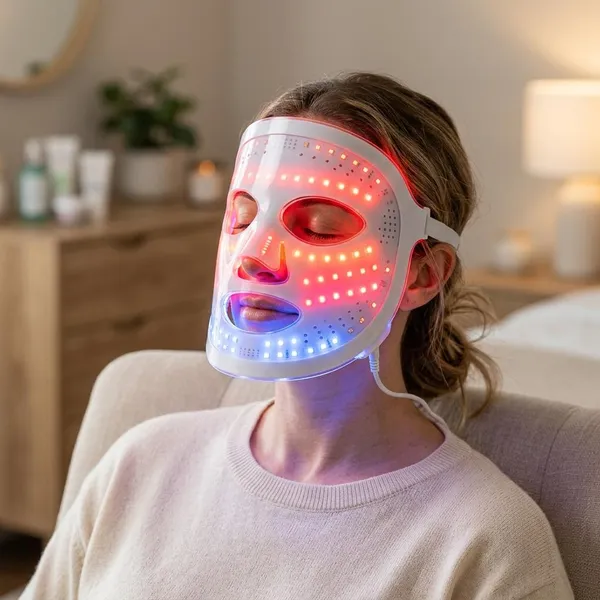
What does visible light energy mean in an LED mask?
In an LED face mask, visible light energy describes the energy carried by visible wavelengths and delivered toward the skin during a session. Three things matter most: the wavelength of the light, the output of the LEDs, and the length of the treatment.
Photon energy depends on wavelength
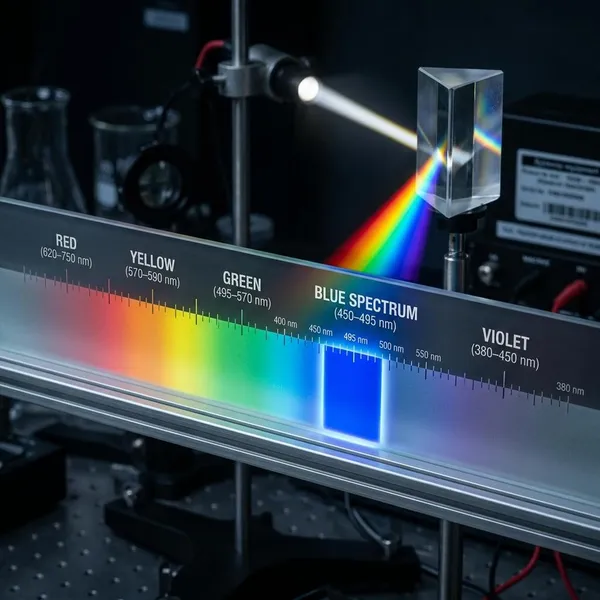
Shorter wavelengths carry more energy per photon. Within visible light, blue photons carry more energy than red photons because blue light has a shorter wavelength.
This physics point is useful, but it should not become the whole buying decision. A person choosing a mask for blemish-prone skin may look at one mode, while someone focused on visible signs of aging may be guided toward another. The "stronger" photon is not automatically the better skincare option.
Delivered energy depends on output and time
The energy delivered during a session depends on both light output and treatment length. A lower-output mask used for longer can sometimes deliver a similar dose to a higher-output mask used for a shorter time, depending on the actual numbers.
- Output tells you intensity: usually listed as irradiance.
- Time tells you duration: the number of minutes per session.
- Dose combines both: the total energy delivered to a skin area.
Absorbed energy depends on the skin and wavelength
Not all light emitted by the mask is absorbed in the same way. Some reflects off the skin, some scatters, and some is absorbed closer to the surface depending on the wavelength.
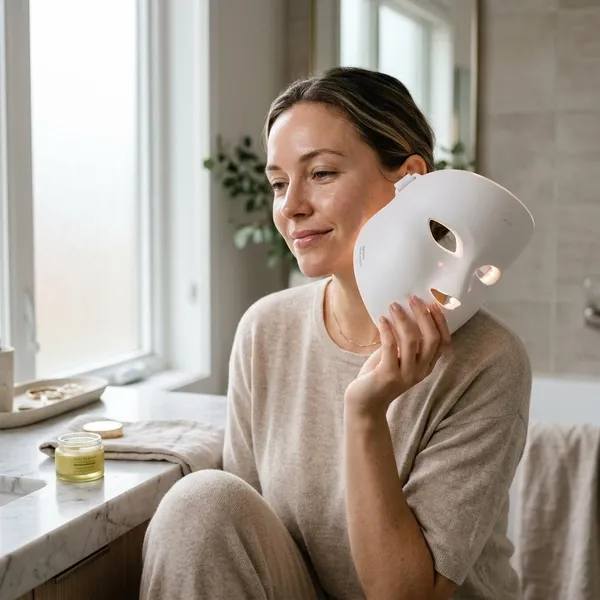
Fit also matters more than many shoppers expect. If a rigid mask sits away from the jawline or leaves uneven gaps around the nose, the cheeks and forehead may receive more consistent exposure than curved or recessed areas. For long-term use, comfort and coverage can matter as much as the number printed on the product page.
How mask colors compare in photon energy
LED mask colors are tied to wavelength. In simple terms, blue sits toward the shorter-wavelength, higher-photon-energy side of visible light, while red sits toward the longer-wavelength, lower-photon-energy side. Green and yellow fall between them.
Blue light has more energy per photon
Blue light has more energy per photon than green, yellow, or red visible light. In LED face masks, blue modes are often marketed for blemish-focused routines because they are associated with more surface-level targets.
Red light has less energy per photon
Red light carries less energy per photon than blue light, but that does not make it a weak option. Longer wavelengths can still be useful when the intended target and treatment dose match the device design.
For someone planning a simple, repeatable routine several nights a week, a well-specified red mode may be more sensible than chasing the highest-energy color. The practical question is not "Which color has the most energetic photons?" but "Which mode is supported for the concern I actually have?"
Green and yellow fall between blue and red
Green and yellow modes sit in the middle of the visible spectrum, so their photon energy falls between blue and red. Some brands market them for tone, brightness, or calming support, but the quality of those claims varies.
Treat extra colors as a bonus only when the brand explains them clearly. If a mask lists several color modes but gives no exact wavelengths, no schedule, and no reason for each mode, the extra buttons may add more confusion than value.
How to read an LED mask's energy specifications
The most useful LED mask specifications are wavelength, irradiance, and dose. If a product page gives all three clearly, you can compare it with much more confidence than if it only talks about color names or brightness.
Nanometers for wavelength
Nanometers show the exact wavelength of the light. Visible light is commonly described as roughly 380 to 700 nanometers, while near-infrared sits beyond visible red and is not visible to the eye.
Exact nanometers help you avoid loose color labels. Two products may both say "red," but one may publish a specific wavelength while the other gives only a color icon. If you are comparing devices seriously, the specific wavelength is the more useful detail.
Milliwatts per square centimeter for irradiance
Milliwatts per square centimeter, often written as mW/cm², describes irradiance or power density. It gives a better sense of how much light power reaches a defined area than photos of glowing LEDs ever will.
Use irradiance together with the recommended session length. A higher number is not automatically better if the routine is uncomfortable, poorly explained, or unrealistic to repeat. For everyday home use, a clear and tolerable schedule usually beats a big claim with no practical guidance.
Joules per square centimeter for dose
Joules per square centimeter, written as J/cm², describes the dose delivered over a session. Dose connects output and time, which makes it one of the most practical numbers on the spec sheet.
- If dose is listed: check whether the session length and frequency are also stated.
- If only irradiance is listed: look for the treatment time so you can understand the routine.
- If neither is listed: be cautious about strong performance claims.
More dose is not always the goal. LED routines are usually designed around a certain balance, so doubling the time because you want faster results may move you away from the intended use.
Why higher energy does not guarantee better skin results
Higher energy does not guarantee better skin results because skin response depends on fit, wavelength, dose, consistency, and the concern being treated. A mask can sound powerful and still be a poor match for your routine.
Different wavelengths interact with different targets
Different wavelengths are chosen for different reasons. Blue, yellow, green, and red modes are not interchangeable simply because they all come from LEDs.
Think of a teenager or adult dealing mainly with occasional breakouts versus someone using a mask for general skin maintenance. Those two users may need different modes, different expectations, and different levels of caution. Matching the wavelength to the concern is more useful than picking the color with the highest photon energy.
Treatment dose affects the response
Dose affects whether a treatment is too low to be meaningful, suitable for the intended routine, or more than the device instructions recommend. The schedule is part of the treatment design, not just a convenience note.
If a mask is meant for 10-minute sessions several times a week, using it for much longer does not automatically make it work better. It may only increase discomfort, dryness, or the chance that you stop using the device consistently.
Device studies matter more than power claims
Evidence tied to the actual device is more useful than general statements about a light color. The same wavelength can perform differently depending on LED placement, output, distance from the skin, mask shape, and recommended timing.
If a brand cannot show product-specific support, look for at least a transparent explanation of wavelength, irradiance, dose, schedule, and precautions. That gives you something concrete to evaluate instead of relying on "clinical-style" wording.
What to check before choosing a light mode
Start with your skin concern, then check whether the mask gives enough information to justify the mode you plan to use. Color preference should come last, after evidence, schedule, fit, and safety.
Evidence for your skin concern
Look for a clear link between the mode and the concern it claims to address. "Glow," "rejuvenation," and "salon-grade" are not enough on their own.
- For blemish-prone skin: check whether the blue mode has a specific wavelength and schedule.
- For visible aging support: look for clear red or related mode details rather than vague anti-aging language.
- For uneven tone or redness claims: be extra careful, because marketing language can be broad.
The mask's recommended treatment schedule
The schedule should tell you how long each session lasts, how often to use the mask, and when it is reasonable to evaluate whether it suits you. A routine that fits your week is more valuable than an ambitious plan you abandon after a few uses.
This is especially important for long-term home use. A short, comfortable routine you can repeat consistently is usually more practical than a device that promises a lot but requires awkward, lengthy sessions.
Fit, coverage, and eye protection
Fit affects how evenly light reaches the face. Check whether the mask sits close enough around the cheeks, chin, forehead, and nose without pressing uncomfortably or leaving obvious gaps.
Eye protection is not a detail to skip, especially with bright visible modes. Look for built-in shielding, blocked eye zones, or clear instructions on whether extra protection is needed. If the mask slips, pinches, or makes your eyes uncomfortable, it is unlikely to be a good daily-use device.
Skin conditions and light-sensitive medications
Be more cautious if you have a history of photosensitivity, pigmentation concerns, active skin irritation, recent skin treatments, or medications that can increase light sensitivity. Home LED masks may look gentle, but they are still light-emitting devices used close to the face.
If you are unsure, check the product warnings and ask a dermatologist or healthcare professional before starting. This is one of those cases where skipping a session is better than testing a device on already reactive skin.
Conclusion
The smartest way to choose an LED mask mode is to stop treating color as a shortcut for quality. Check the wavelength first, then look at output, dose, schedule, fit, and safety guidance. A clear, well-matched routine you can use consistently is usually a better choice than a brighter-looking mask with vague power claims.