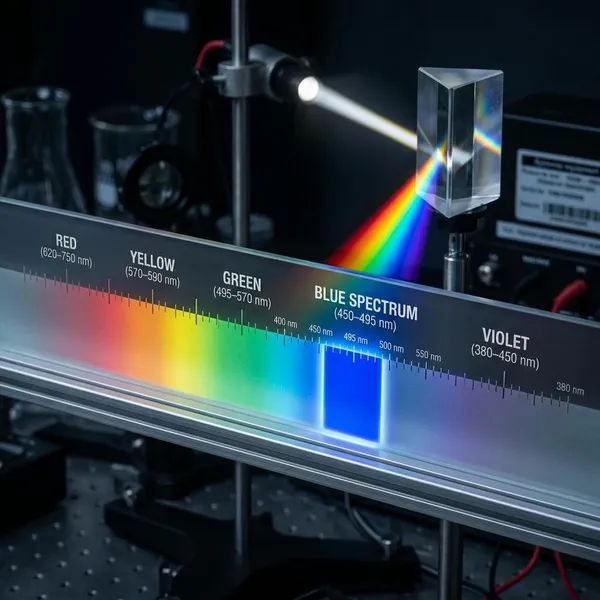
The wavelength of red light is usually given as about 620 to 700 nm. Some references stretch the upper end toward 750 nm, but for everyday reading of charts, LEDs, lasers, or product labels, the safest first check is the actual nanometer number rather than the color name.
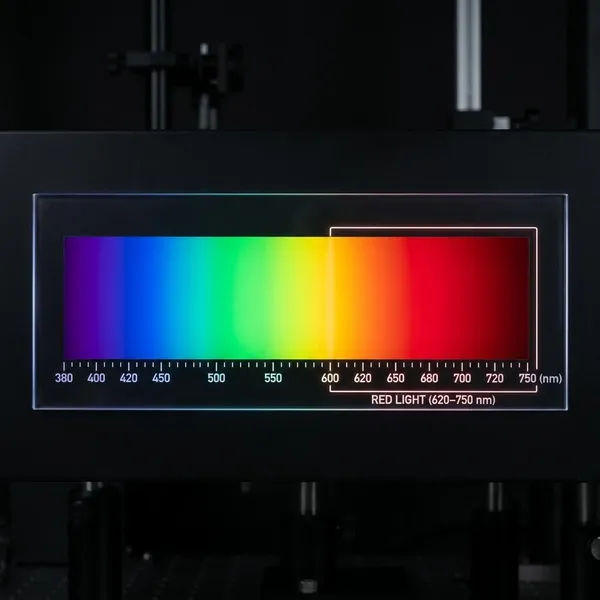
Where does red light sit in the visible spectrum?
Red sits at the long-wavelength end of visible light. It comes after orange and sits just before infrared, so it is the visible color closest to the point where human eyesight starts to fade out.
Red comes after orange light
Orange is commonly placed around 590 to 620 nm, and red usually begins around 620 nm. A light listed at 610 nm may look orange-red, while 630 nm or 650 nm is much more comfortably in the red range.
Red sits next to infrared
Red is the last visible color before infrared. A common boundary is around 700 nm, although some sources put the edge slightly higher because the change is gradual rather than a hard line.
- 660 nm: visible red, often described as deep red.
- 700 nm: near the red edge and may look dimmer.
- 810 or 850 nm: near-infrared, not normally seen as red by the eye.
That distinction matters when comparing red light panels or technical LEDs. A device can include both visible red and near-infrared wavelengths, but those are not the same thing.
Longer red wavelengths have lower frequencies
As wavelength gets longer, frequency gets lower. That is why red sits opposite blue and violet on the visible spectrum: red has longer wavelengths and lower frequencies than those shorter-wavelength colors.
Why do red light wavelength ranges vary?
Red light ranges vary because color boundaries are convenient labels, not physical walls. The spectrum changes continuously, and the human eye becomes less sensitive near the far-red edge.
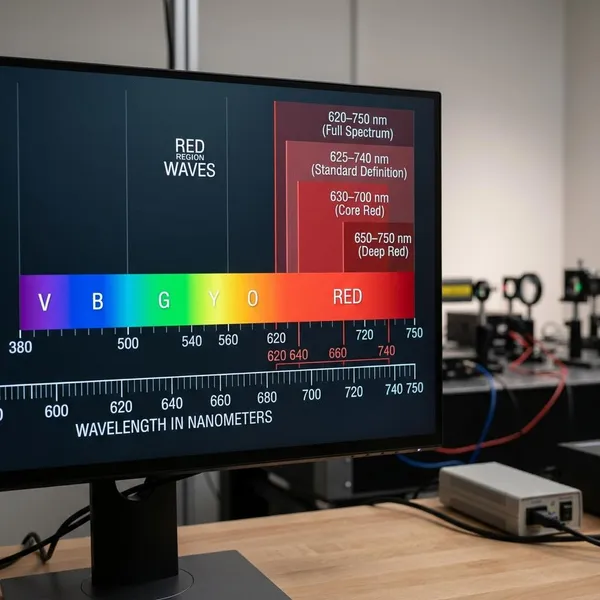
For school charts, 620 to 700 nm is usually enough. For deeper technical discussions, photography, lighting, or device specifications, you may see wider ranges because some very deep red can still be faintly visible under certain conditions.
Spectrum boundaries are not fixed
There is no exact point where orange instantly becomes red, or where red instantly becomes infrared. A chart that ends red at 700 nm is usually simplifying the spectrum so it is easier to read.
A more technical source may extend red to 730 nm or 750 nm to account for faint far-red visibility. Neither approach is automatically wrong; they are drawing the boundary for different purposes.
Human vision varies near the red edge
Near 700 nm, red can appear darker, duller, or harder to notice. One person may still see a very deep red glow in a dim room, while another person may barely detect it.
Viewing conditions also change the result. A controlled lab setting, a dark room, a bright shop display, and a small indicator LED can make the same wavelength feel different to the eye. That is why visibility is a useful clue, but not a perfect test.
Different sources use different cutoff points
Different sources choose cutoffs based on what they are trying to explain. A classroom diagram may use neat color bands. A laser seller may list a precise wavelength such as 635 nm or 650 nm. A red light therapy product may mention 630 nm, 660 nm, or a mix of visible red and near-infrared values.
- For learning the spectrum: use 620–700 nm as the clean reference range.
- For buying a product: check the exact nm value before trusting the word "red."
- For mixed red/infrared devices: separate visible red numbers from near-infrared numbers.
Red light vs other wavelengths
Comparing red with nearby and distant wavelengths makes the numbers easier to place. Red is longer than orange, much longer than blue, and shorter than infrared.
This is the fastest way to judge an unfamiliar number on a label. A 650 nm source is red; a 470 nm source is blue; an 850 nm source is infrared. The color name may be vague, but the wavelength usually gives you the better answer.
Red has longer wavelengths than orange
Red begins where orange usually ends, around 620 nm in many references. So a 600 nm light may look warm and reddish, but it is still closer to orange than a 650 nm source.
For display lighting or small indicator LEDs, this difference can be noticeable. If you want a clearly red appearance rather than an amber or orange-red look, a value well above the orange boundary is the safer choice.
Red has much longer wavelengths than blue
Blue light is usually around 450 to 495 nm, far below the red range. That puts blue and red on opposite sides of the visible spectrum.
Red has shorter wavelengths than infrared
Red remains visible light; infrared sits beyond the visible red edge. A 660 nm LED is red, while an 850 nm LED is near-infrared and usually does not appear red to the eye.
This matters most in two everyday situations. If you are buying a visible red light, stay in the low- to mid-600 nm range. If you are comparing a red light therapy panel, check whether the listing includes both red and near-infrared wavelengths, because those numbers describe different parts of the spectrum.
Conclusion
For most practical uses, treat red light as roughly 620 to 700 nm, with the understanding that some sources include faint far-red wavelengths up to about 750 nm. If you are reading a chart, the range is enough; if you are choosing a laser, LED, therapy panel, or lighting product, the exact nanometer value is the detail to check first.