The safest answer to which lasers are best for hair removal is not one machine for everyone: Alexandrite often suits light skin with dark hair, diode works for many light to medium skin tones, and long-pulsed Nd:YAG is usually the safer choice for darker skin. Before comparing prices or packages, check your skin tone, hair color, recent tanning, and whether the clinic actually has experience treating people like you.

Which lasers are best for different skin tones?
Skin tone matters because hair removal lasers target pigment in the hair while trying to avoid overheating pigment in the skin. The stronger the contrast between dark hair and lighter skin, the easier that job usually is. When skin contains more pigment, the clinic has to be more careful with wavelength choice, settings, cooling, and test spots.
| Laser type | Often a good fit for | Main caution |
|---|---|---|
| Alexandrite | Light to fair skin with dark, coarse hair | Can be riskier on tanned or deeper skin |
| Diode | Many light to medium skin tones | Results depend heavily on settings and cooling |
| Long-pulsed Nd:YAG | Medium-deep to dark skin tones | May be less impressive on fine or pale hair |
What else affects the best laser choice?
The device is only one part of the decision. Hair color, hair thickness, body area, recent sun exposure, cooling, and operator skill can change both safety and results. A person with pale skin and black underarm hair is a very different candidate from someone with medium skin, fine facial hair, and recent beach exposure.
Hair color and thickness
Dark, coarse hair usually responds best because it gives the laser more pigment to target. Fine blond, gray, white, and many red hairs are much harder to treat, even with a good machine. If the hair is pale or very fine, ask the clinic directly whether you are likely to get meaningful reduction before buying a package.
Treatment area and hair density
Underarms and bikini areas often respond well because the hair is usually coarse and dense. Legs and backs can also improve a lot, although they take more time simply because the area is larger. Facial hair needs a more careful expectation check, especially around the chin, jawline, or neck, where hormones can keep triggering new growth.
Recent tanning and sun exposure
Recent tanning can make a previously suitable laser less safe. More pigment near the skin surface reduces the contrast between skin and hair, which can raise the risk of burns, irritation, or dark marks after treatment.
- Tell the clinic about sun exposure: include vacations, tanning beds, and self-tanner.
- Do not treat "almost back to normal" skin casually: mild color change still matters.
- Be flexible with timing: delaying a session is better than treating irritated or tanned skin aggressively.
Device settings and skin cooling
Settings can make the same laser perform very differently. Pulse duration, energy level, spot size, overlap, and cooling affect whether heat reaches the follicle without over-stressing the skin. Cooling is not just about comfort; it helps protect the surface, especially on sensitive areas or skin with more pigment.
How do you choose a suitable laser clinic?
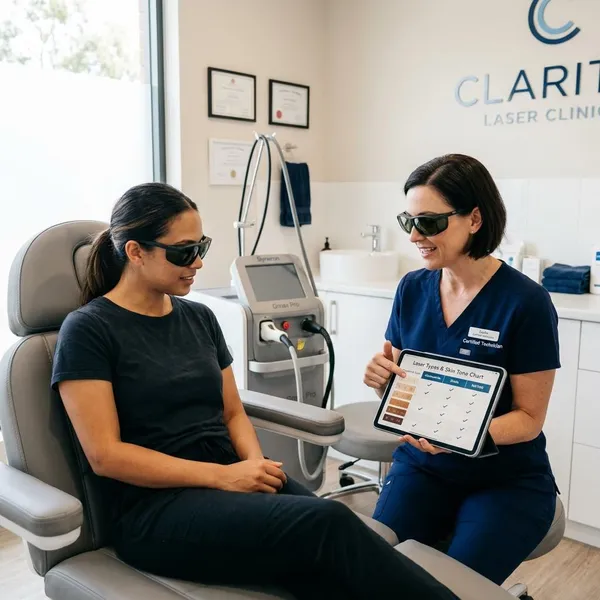
Start with the clinic, not the deal. A suitable provider should be able to explain why a specific laser is appropriate for your skin and hair, what risks apply to you, and what kind of maintenance may be realistic. If the answer is only "our machine works for everyone," keep asking questions.
- Ask which laser will be used on you. Get the actual type, not just the brand name.
- Check experience with your skin tone. This matters most for darker, easily tanned, or reactive skin.
- Discuss hair color and area. Pale or fine hair may not be worth treating in the same way as coarse dark hair.
- Ask about cooling and test spots. These are practical safety checks, not luxury extras.
- Get expectations in writing. Session ranges, aftercare, and likely maintenance should be clear before payment.
Choose a provider experienced with your skin tone
Experience with your skin tone is more important than owning a famous machine. Darker skin, mixed pigmentation, recent tanning, and a history of hyperpigmentation all require more careful judgment. Ask a direct question: "How often do you treat people with my skin tone and this treatment area?" A vague answer is not reassuring.
Confirm the laser type before booking
Some clinics advertise laser hair removal but use IPL, while others offer only one device and present it as suitable for everyone. Ask whether the treatment will be Alexandrite, diode, long-pulsed Nd:YAG, IPL, or a multi-wavelength platform. For darker skin, confirm whether true long-pulsed Nd:YAG is available; for light skin with coarse dark hair, ask whether Alexandrite or diode is being considered and why.
Ask for a skin assessment and test spot
A proper assessment should cover your natural skin tone, current tan, medication use, pigment-change history, hair color, hair thickness, and sensitivity. A test spot is especially sensible if you have medium to dark skin, reactive skin, or you are treating an area where marks would bother you. It is a small step, but it can reveal how your skin responds before a full session.
Get clear expectations for results and maintenance
Laser hair removal is better described as long-term reduction, not a promise that every follicle is gone forever. Most people need a series of treatments because hair grows in cycles, and some areas need touch-ups later. This is especially true for facial hair, hormonally influenced growth, or body areas where new hair can develop over time.
It also helps to compare professional treatment with at-home IPL honestly. IPL may reduce hair for some people with fair skin and dark hair, but in-office lasers are usually more targeted and predictable when the candidate is suitable. If your goal is occasional light maintenance, IPL may feel acceptable; if you want stronger reduction on coarse hair, professional laser is usually the more serious option.
Conclusion
The best choice is the laser that matches your skin safely, has enough pigment to target in the hair, and is used by someone who knows how to adjust the treatment. Alexandrite, diode, and long-pulsed Nd:YAG can all be good options in the right situation, but the real decision should happen after a skin assessment, a clear device explanation, and honest expectations about results and maintenance.